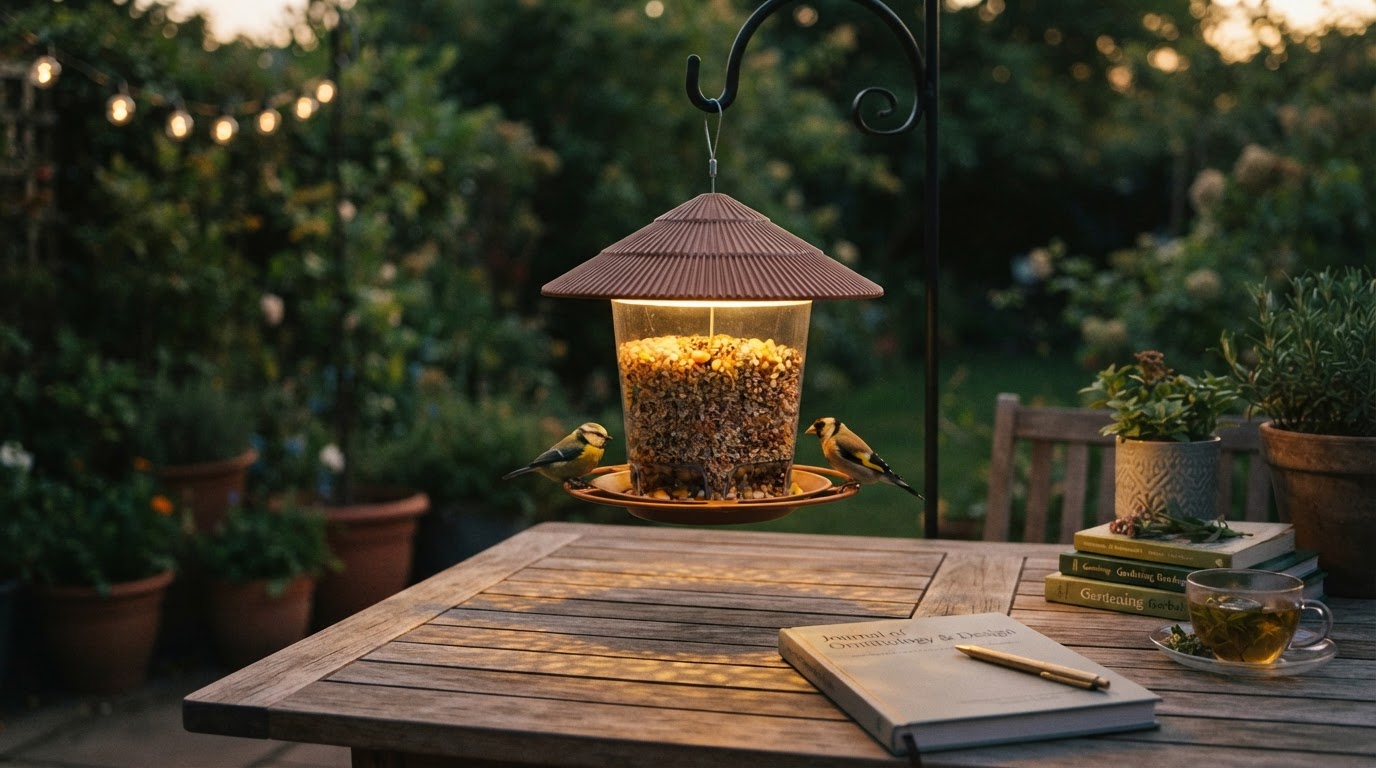
Solar Lantern Feeder Lighting Efficiency Framework
 Maya ChenContributing Editor
October 21, 2026 — The market for dual-purpose garden hardware has shifted toward the Solar Lantern Feeder, a category that attempts to bridge the gap between ornithological utility and aesthetic illumination. While the conventional wisdom says that garden lighting should be purely ornamental, recent consumer behavior suggests a demand for high-utility items that function long after dusk.
Backyard enthusiasts are increasingly looking for unique bird feeders that light up at night, a trend noted by Good Housekeeping, which highlights how these units double as night lights for otherwise dark garden corners. However, the efficacy of these devices depends entirely on their ability to convert solar energy into sustained lumens without disrupting the feeding habits of local wildlife. Many generic models fail to provide adequate battery capacity, leading to a rapid decline in light output just hours after sunset.
The Three Metrics of Illumination
Run the math: a standard solar-powered feeder requires a specific energy-to-output ratio to be effective as both a feeder and a lantern. The Solar Lantern Feeder utilizes a Ni-MH AAA rechargeable battery, a common but critical component that dictates the longevity of the LED glow. Here's the part nobody talks about: the placement of the solar panel relative to the seed tray often creates a trade-off between charging efficiency and seed protection. A high-quality unit must feature a weather-resistant IP rating to prevent moisture ingress from ruining the internal circuitry during autumn rains. While many users focus on the visual appeal of a [Mosaic Solar Bird Feeder](/blog/mosaic-solar-bird-feeder), the technical requirement for a successful night-light feeder is a consistent 6-to-8-hour runtime. Data from eBay listings for similar LED hanging feeders indicates that these units typically rely on a single 1.2V cell, which is sufficient for ambient glow but insufficient for area task lighting. When selecting a Solar Lantern Feeder for bird lovers, the priority should be on the solar cell's surface area. A smaller panel will struggle to reach full charge during the shorter daylight hours of October, regardless of the LED's efficiency. Furthermore, the structural integrity of a [Copper Solar Lantern Feeder](/blog/copper-solar-lantern-feeder) provides better heat dissipation for the electronics compared to plastic alternatives, ensuring the internal components do not degrade over multiple seasons of use.
Expert tip: To maximize the lifespan of the AAA rechargeable battery, ensure the solar panel is cleaned bi-weekly with a damp cloth; accumulated dust can reduce charging efficiency by up to 30%, leading to premature battery failure.
This focus on technical specs is often ignored in favor of aesthetics, such as the intricate patterns found in a Mosaic Solar Bird Feeder. I'll change my mind when manufacturers start providing standardized lumen output ratings for these devices, but until then, the Solar Lantern Feeder remains the most reliable intersection of these two categories.
Sources
- This Solar Bird Feeder Is a Game Changer (Wait for Nightfall!)
- I didn't know bird feeders could do THIS… and now I want ... - Instagram
- Solar Hanging Bird Feeders for The Outdoors - Cute Fai... - eBay